Gemini_Generated_Image_a59bg6a59bg6a59b

Join Nass Online’s Graphic Design Internship and Boost Your Creative Career

Are you passionate about design and eager to gain hands-on experience in the creative industry? Nass Online, a leading IT and academic services company based in Trivandrum, offers an exciting Graphic Design Internship that helps you turn your ideas into impactful visual content.

About the Internship

The Graphic Design Internship at Nass Online is designed for students, freshers, and aspiring designers who want to build a strong foundation in both digital and print design. The program provides real-world exposure, allowing you to work on projects for branding, social media, websites, and marketing materials.

Key Learning Areas:

  • Branding & Logo Design: Develop unique logos and brand identities that leave a lasting impression.

  • Web & UI/UX Design: Design user-friendly websites and applications.

  • Digital Marketing Visuals: Create social media posts, banners, and online ads.

  • Print Design: Work on brochures, flyers, and other offline marketing materials.

Interns will gain experience with industry-standard tools like Adobe Photoshop, Illustrator, and Figma, preparing them for a professional career in design.

Internship Details

  • Location: Trivandrum, Kerala (with flexible online options)

  • Duration: 6 months

  • Eligibility: Open to students, freshers, and creative individuals

  • Benefits: Internship certificate, portfolio development, mentorship from experienced designers, and exposure to live projects

Why Choose Nass Online?

At Nass Online, you don’t just intern—you grow. The company is known for its expertise in IT solutions, academic support, and creative services. By joining the Graphic Design Internship, you’ll get:

  • Hands-on Experience: Work on live projects and see your designs implemented.

  • Professional Mentorship: Learn directly from experienced designers.

  • Skill Enhancement: Build a strong portfolio that showcases your talent.

  • Career Opportunities: Exceptional interns may transition to full-time roles.

Final Thoughts

Whether you aspire to work in a creative agency, launch your own design projects, or become a professional graphic designer, Nass Online provides the perfect platform to develop your skills, build a portfolio, and gain industry experience.

Gemini_Generated_Image_q363ezq363ezq363

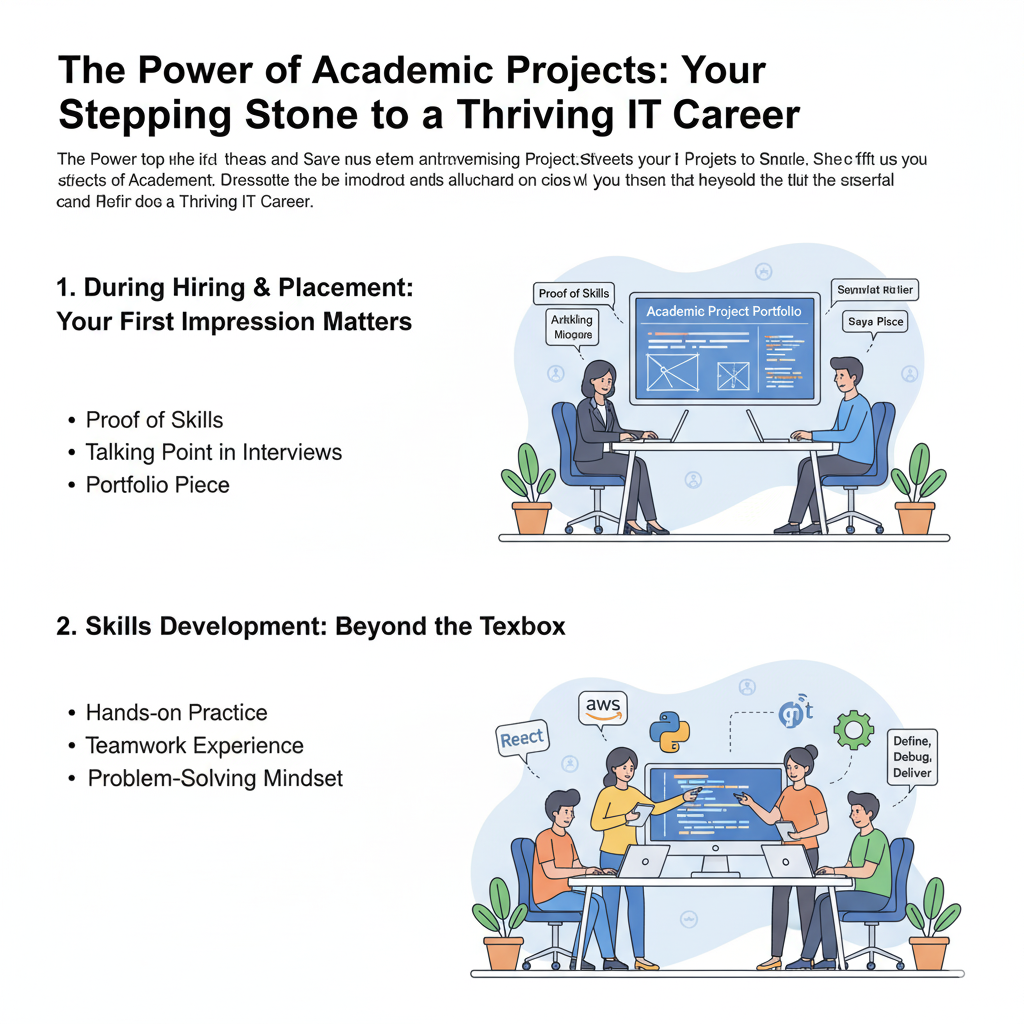
The Power of Academic Projects: Your Stepping Stone to a Thriving IT Career

Are you an IT student wondering how to stand out in a competitive job market? Or perhaps an educator looking to make learning more impactful? The answer often lies in the humble academic project. More than just an assignment, these projects are dynamic tools that shape careers, foster innovation, and bridge the gap between classroom theory and real-world industry demands.

Let’s delve into the complex roles and amazing influence of academic assignments within the IT sector.

  1. At Hiring & Placement: Your First Impression Counts

For new graduates, a school project isn’t merely a bullet on your resume—it’s likely your strongest case for why you should work there.

Evidence of Competence: Recruiters do not want only good grades; they want to know whether you can implement what you have learned. Your project is the best way to show your hands-on understanding of programming, databases, networking, AI, and so forth in actual situations.

Talking Point during Interviews: Be ready with answers such as, “Tell me about your project.” This is your chance to highlight your knowledge, problem-solving skills, and teamwork capabilities to both technical and HR panelists.

Portfolio Piece: A project done well serves as a concrete portfolio piece, making your resume stand out above the rest, particularly for people new to the career path.

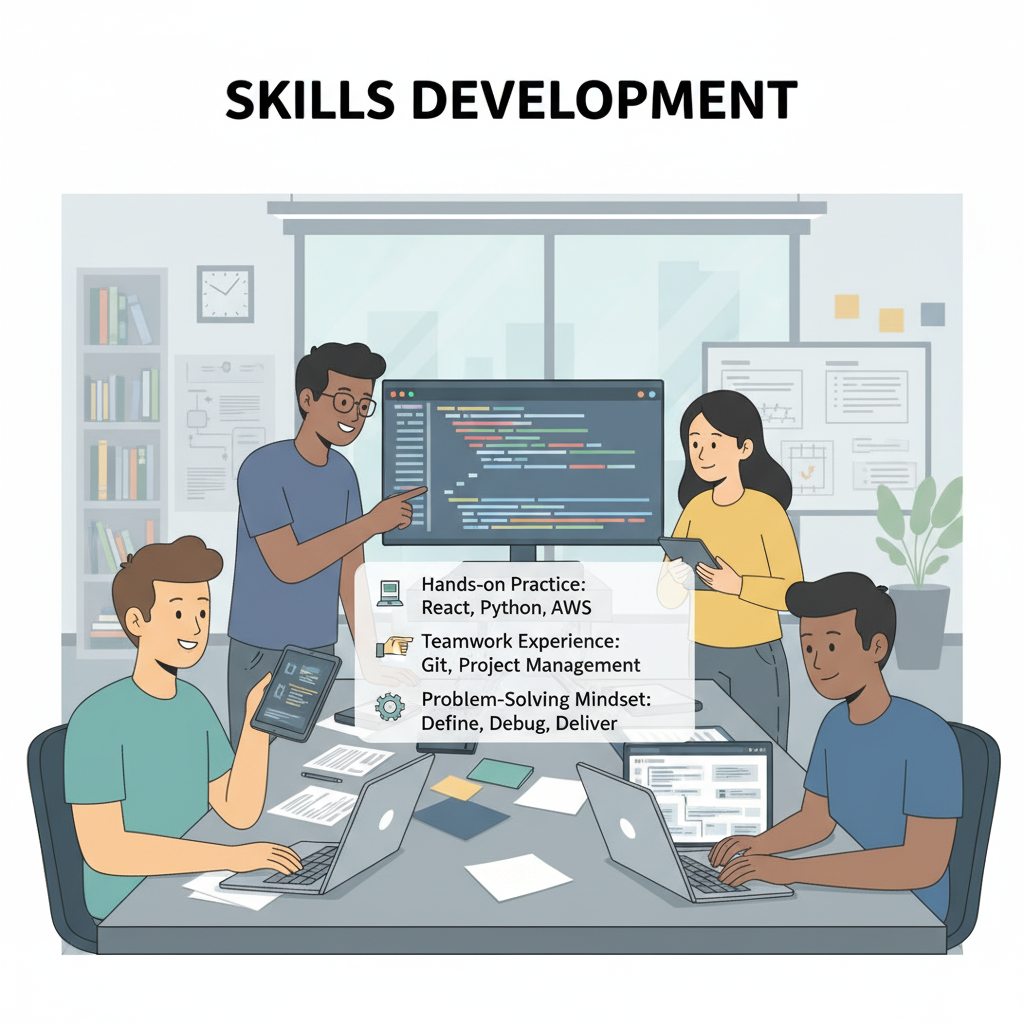
  1. Skills Development: Beyond the Textbook

Academic projects are your own training ground, providing priceless experience working hands-on that textbooks just can’t offer.

Hands-on Practice: Rather than simply reading about React, Python, or AWS, projects enable you to work hands-on with these tools, languages, and frameworks. Practical exposure makes theoretical knowledge stick.

Teamwork Experience: The majority of projects are team-oriented, providing invaluable experience with collaboration software, version control (hello, Git!), and project management fundamentals.

Problem-Solving Attitude: You’ll get to know how to frame problems, design solutions, debug endlessly, and finally, deliver results—exactly the same way you’ll have to go about any IT role.

  1. Industry Relevance: Bridging the Gap

Carefully designed educational projects are not merely scholastic exercises; they are immediate conduits to industry preparedness.

Bridging Industry and Academia: These projects tend to replicate actual tasks that are used in IT firms, whether constructing web applications, mobile applications, AI models, or cybersecurity solutions.

Domain Exposure: Initiatives in trendy domains such as cloud computing, AI, cybersecurity, DevOps, and data analytics indicate that you’re up to date with technological trends to businesses.

Work-Readiness: Employers like to hire candidates who can transition smoothly. Projects show that you already have an understanding of industry workflow and expectations.

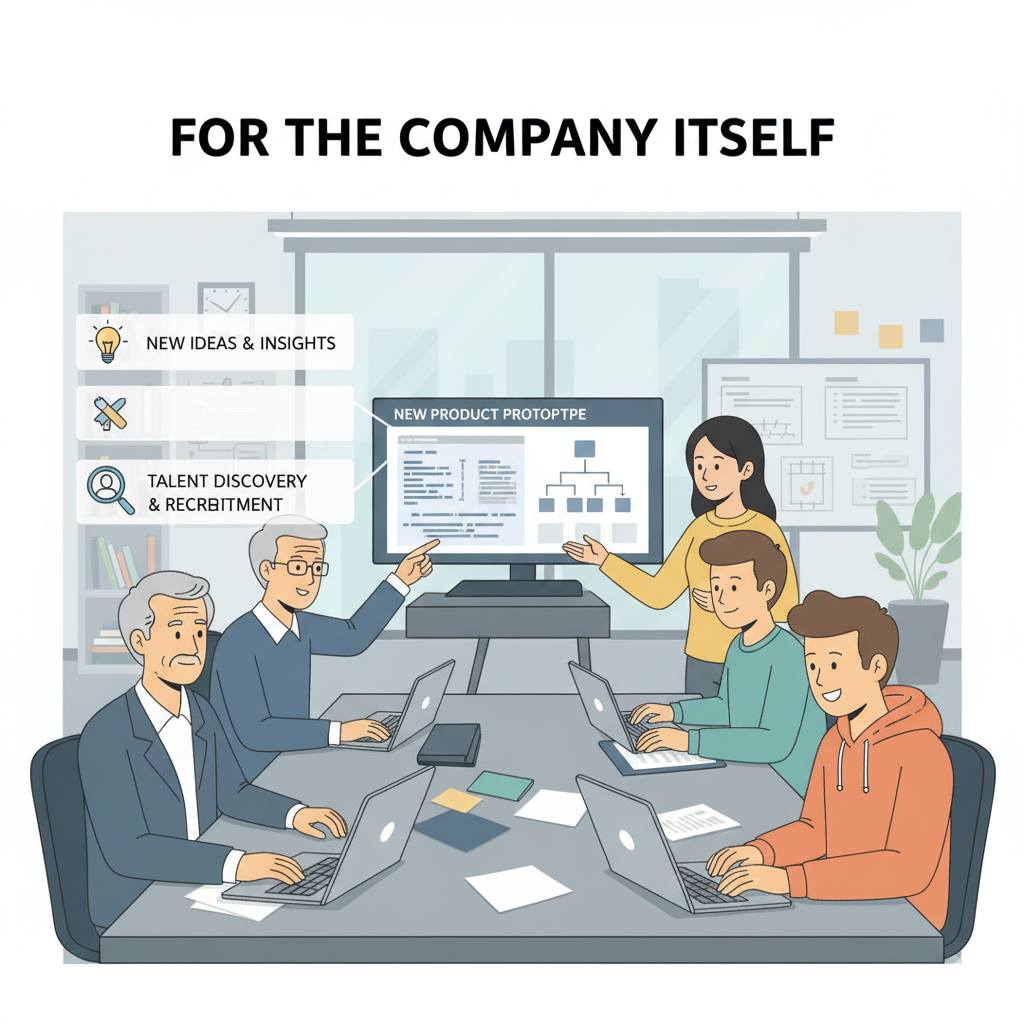
  1. For the Company Itself: A Win-Win Partnership
  • It’s not only the students who gain! When corporate ITs interact with academic projects, it becomes a two-way beneficial ecosystem.
  • Companies benefit:
  • New Concepts and Research Findings: Students tend to bring new ideas and original methods.
  • Early Talent Discovery and Recruitment: It is a great means of identifying high potential candidates early.
  • Cost-Effective Prototypes: Students can assist in creating prototypes for new products at minimal cost.

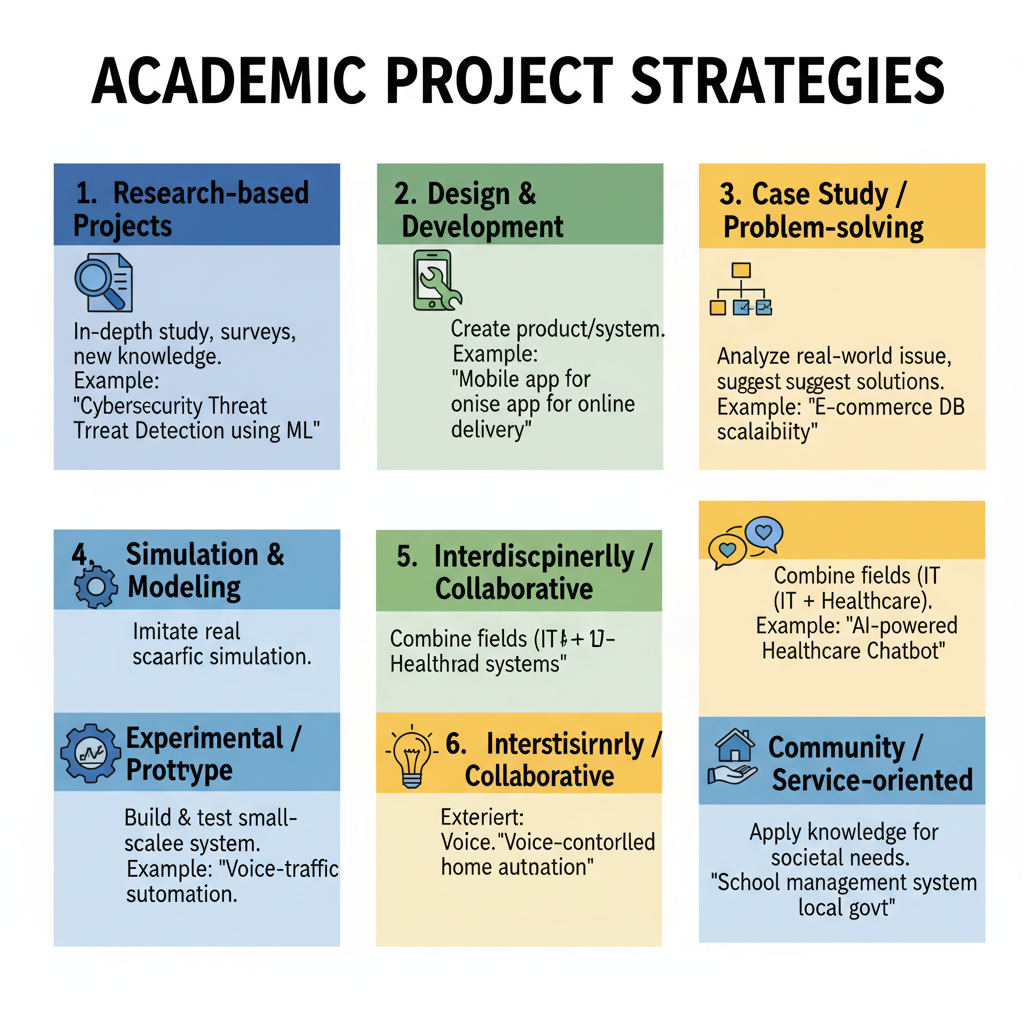
Academic Project Strategies: Your Blueprint for Success

Not every project is equal. Learning various strategies will assist you in selecting the correct path for your learning and career objectives.

  • Research-based Projects:
    • Strategy: Intensive research through surveys, experiments, or literature reviews.
    • Goal: Create new knowledge, analyze trends, or validate hypotheses.
    • Example (IT): Research on “Cybersecurity Threat Detection using Machine Learning.”
  • Design & Development Projects:
    • Strategy: Develop a new product, system, or tool.
    • Goal: Real-world application of software, hardware, or system design skills.
    • Example (IT): Creating a mobile app for ordering food online.
  • Case Study / Problem-solving Projects:
    • Strategy: Work through a real-world problem step by step and propose/implement solutions.
    • Goal: Enhance decision-making and problem-solving skills in realistic contexts.
    • Example (IT): Examining database scalability in an e-commerce website.
  • Simulation & Modeling Projects:
    • Strategy: Employ simulations or models to mimic real-world scenarios.
    • Goal: Grasp system behavior under various conditions.
    • Example (IT): Network traffic simulation to analyze DDoS attack prevention.
    • Strategy: Develop and experiment with a pilot-scale version to test feasibility.
    • Goal: Innovation, proof of concept, and testing ideas.
    • Example (IT): Proof-of-concept for a voice-operated home automation system.
  • Interdisciplinary / Collaborative Projects:
    • Strategy: Integrate knowledge across multiple disciplines (e.g., IT + Business, IT + Healthcare).
    • Goal: Demonstrate how IT applies to various industries.
    • Example: “AI-powered Healthcare Chatbot.”

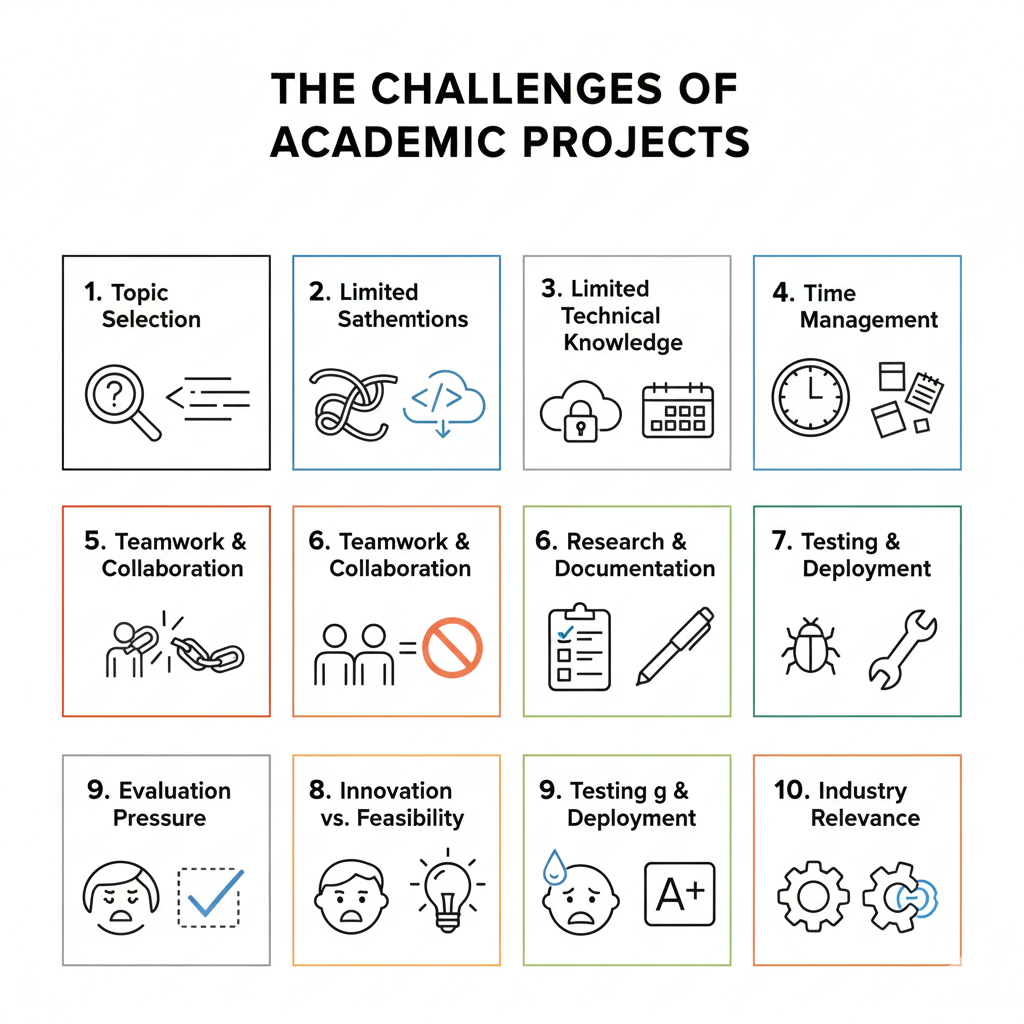
The Challenges of Academic Projects: Navigating the Obstacles

While extremely useful, university projects also have their drawbacks. Preparing for these can assist you in overcoming them successfully.

  1. Topic Selection: Selecting a valid, innovative, and pragmatic topic may be challenging. Don’t select too general or too specific topics.
  2. Limited Technical Knowledge: You may not have complete knowledge of some tools or languages. Welcome the learning curve!
  3. Resource Shortages: Availability of software, cloud space, or data can be a problem. Be creative and seek open-source options.
  4. Time Management: Work vies with classwork, exams, and internships. Organize carefully to stay away from last-minute frustrations.
  5. Teamwork & Cooperation Problems: Miscommunication and uneven work are issues. Learn tools such as Git for version control and work proactively to manage the team.
  6. Research & Documentation: Code is not the only thing! Good report writing, citation, and presentation are essentials.
  7. Innovation vs. Feasibility: Be creative, but temper it with what’s realistically within your limits.
  8. Testing & Deployment: Coding shouldn’t be the end goal of projects. Adequate testing, debugging, and deployment are necessary for a full solution.
  9. Evaluation Pressure: Prioritize actual learning, not grades, to eschew shortcuts such as plagiarism.
  10. Industry Relevance: Make sure your project is relevant to today’s industry needs in order to gain the most value for job placement.

The Unmistakable Impact of Academic Projects

The ripple effect of an excellent academic project spreads much wider than just the individual student.

  1. On Students:
  • Developing Skills: Practical experience sharpens technical skills.
  • Problem-Solving Skills: Projects instill analytical thinking and solution development.
  • Building Confidence: Completions give a boost to self-confidence.
  • Portfolio Strength: A valuable asset for resumes and professional profiles.
  • Connecting Theory and Practice: Converts classroom ideas into practical knowledge.
  1. On Career and Employment:
  • Interview Edge: A major competitive advantage for new graduates.
  • Job Preparedness: Replicates actual workflows.
  • Internship Opportunities: Opens doors to enriching industry experience.
  1. On Institutions:
  • Academic Reputation: Highlighting innovative projects adds prestige.
  • Industry Tie-ups: Develops collaborations with IT companies.
  • Research Contributions: May result in papers, patents, and new concepts.
  1. On IT Companies and Industry:
  • Talent Identification: Facilitates identification of skilled candidates at an early stage.
  • Fresh Ideas: Students introduce creativity and fresh approaches.
  • Prototype Development: Certain projects may lead to startups or new company products.


Academic assignments are not just tasks; they are nurseries for potential, creativity, and professional achievement. Take up the challenge, learn through the experience, and see how your assignments clear the path for an exceptional future in the world of IT!

unnamed

Master Python with NASS ONLINE Pvt Ltd: Learning That Shapes Your Future

Are you trying to launch a career in coding? Professional Python learning programs are available from NASS Online Pvt Ltd, which will help you advance from the fundamentals to skills that are ready for the workplace. You’ll gain real-world knowledge of one of the most in-demand programming languages through flexible online learning, practical projects, and guidance from expert mentors. NASS Online helps you lay a solid foundation and prepare for a successful IT career, regardless of your level of experience.

Student Benefits at NASS Online Pvt Ltd

  • Hands-On Learning – Work on real projects and practical coding exercises.
  • Certified Programs – Get certificates that strengthen your resume.
  • Career Guidance – Mentorship and support to prepare for job interviews.
  • Flexible Learning – Online and offline options to suit your schedule.
  • Expert Mentors – Learn directly from experienced professionals.
  • Doubt-Clearing Sessions – Extra classes and one-on-one support.
  • Placement Support – Opportunities for part-time jobs and career growth.

Learning at NASS Online Pvt Ltd is more than just theory. Through daily exercises, real-time projects, and problem-solving sessions that gradually build confidence, every student is encouraged to practice coding. The emphasis is on practical training, where learners write code, troubleshoot bugs, and complete tasks that mirror real industry challenges. This ensures students not only understand concepts but can apply them effectively in real-world situations.

Why Learn Python?

  • Easy for Beginners: Python is well-known for its simple and beginner-friendly syntax.

  • Versatile Applications: From web development to data science, automation, and artificial intelligence, Python powers today’s most advanced technologies.

  • High Demand: With the growth of AI, data science, and machine learning, Python is one of the most sought-after skills worldwide.

Python is versatile, widely used, and provides access to excellent career opportunities.

Placement Opportunities

While guaranteed placements aren’t mentioned, NASS Online provides placement support and part-time job opportunities that can grow into full-time roles. The skills gained from Python learning here also boost employability in web development, automation, and data-driven fields.

Looking to launch your coding journey?  NASS Online Pvt Ltd offers practical training and internships in Python, helping students gain real-world experience and build the skills needed for a successful IT career.

unnamed

Digital Marketing Courses & Internship at NASS ONLINE PVT LTD – Boost Your Career

Do you want to advance your career and obtain practical experience in digital marketing? For students, recent graduates, and anyone else with an interest in online marketing, NASS ONLINE PVT LTD provides a thorough internship in digital marketing. This internship is the ideal way to develop skills that are important in today’s digital world because it provides practical training, exposure to real-world projects, and industry experts’ mentoring.

Why Choose a Digital Marketing Internship?

One of the industries with the quickest rate of growth in the world is digital marketing. You can gain hands-on experience in SEO, social media marketing, content production, Google Ads, email marketing, and other areas by working as an intern at NASS ONLINE PVT LTD. In addition to improving your resume, this internship gives you the skills that employers value.


Best Digital Marketing Course in Trivandrum

What You Will Learn

During the internship, you will get hands-on experience in:

  • SEO (Search Engine Optimization): Learn how to rank websites higher on Google.
  • Social Media Marketing: Master platforms like Instagram, Facebook, and LinkedIn.
  • Content Creation & Copywriting: Create engaging posts, blogs, and ads.
  • Email Marketing & Automation: Build campaigns that convert.
  • Analytics & Reporting: Understand data to optimize marketing strategies.

Benefits of Interning at NASS ONLINE PVT LTD

  • Gain real-time exposure to live projects.
  • Work under experienced mentors in digital marketing.
  •  Receive internship certificate upon completion..
  • Opportunity to get full-time placement in the company
  • Build a professional portfolio showcasing your work.
Best Digital Marketing Course in Trivandrum

Conclusion

More than just training, a digital marketing internship at NASS ONLINE PVT LTD serves as your springboard to a successful career in the digital industry. Don’t pass up the opportunity to develop, learn, and acquire worthwhile experience that will help you stand out from the competition. Start your path to becoming an expert in digital marketing by applying today!

Google core updates March 2025

What are the changes in SEO after the March 2025 core update?

Google core updates March 2025

 A Google Core Update is devoted to making changes in the way search engines review and rank webpages. The March 2025 Core Update, which took place from the 13th to the 27th of March, was a major update with a torrent of change. These are the main changes in this core update.


  • Relevance and Usefulness of Content: Now Google is getting even better in differentiating between content that helps a user versus something like outdated or very generic content that is more likely to be affected by a drop in ranking.


  • Refined Understanding of Intent: Boosting Google’s effort in finding appropriate answers to user queries. Whether considered a how-to guide or an in-depth analysis, user relevance is where to start.


  • Reversal of Low-Quality SEO Tactics: Practice pages which are overwrought with methods like keyword stuffing, thin content, AI-generated content, may be punishable.


  • Now greater emphasis on E-E-A-T: Experience, Expertise, Authority, and Trustworthiness -are now the constituents that govern Google’s minds when really judging your content. Google likes content that is produced by folks who actually know what they are talking about.


There are also many major things that should be focused on by digital marketers. March 2025 update create both challenges and an opportunity to digital marketers like,


  1. Review and Revamp Your Content


The Importance: Regular content audits inform missing patches in quality and relevance. Update old posts, contribute fresh insights to current articles, and ensure that every piece gives real value at this moment.


Action Steps:

  • Identify pages that have lost rankings.
  • Refresh content with new stats, new perspectives, and deeper explanations.
  • Eliminate duplicative or low-quality content that could hurt performance overall.


  1. User-centered Content


  • Pay-off: Content that really helps earns brownie points with Google’s updated algorithms. Whether you are creating a blog post, a video, or a product page, generate it with your audience in mind.
  • User Intent: Make certain your content is oriented towards specific questions. Instead of a generic guide titled, “Starting a Blog,” give them a step-by-step tutorial on how to avoid the major pitfalls and what actionable strategies to put into place.


  • E-E-A-T in Practice:

-Show off your subject expertise with detailed author bios and credentials.

            -Cite credible sources and include real-life examples or case studies.

– Foster user interaction and gather feedback to strengthen trust and boost engagement.


  1. Tune-Up Your Technical SEO


  • Site Speed: Fast-loading pages and mobile-friendly designs have never been more important. A website that can provide a seamless experience for end users becomes a better-ranking site.


  • Structured Data: Use schema markup appropriately to help search engines better understand your content.


  • Navigation and Usability: Your site must be user-friendly, with a logical form that helps both users and search engines find what they need quickly.


  1. Observation, Analysis, and Adaptation


  • Analytics: Keep a close watch on your website’s performance metrics. Identify differences in traffic, bounce rates, and conversion rates, and adjust your strategy in response.


  • Feedback Loops: Identify new opportunities and solve problems created due to the upgrade by using Google Search Console and third-party SEO software.


In conclusion, the March 2025 SEO Core Update is a clear message from Google that quality and user relevance are mandatory for digital marketers; this means moving away from outdated SEO techniques and embracing a strategy that puts people first.


Points to be considered:


  • Audit Regularly: Keep your content fresh and relevant.
  • Focus on Users: Understand and address your audience’s needs.
  • Leverage E-E-A-T: Build trust by showcasing genuine expertise.
  • Optimize Technically: Ensure your website is fast, responsive, and easy to use
  • Adapt and Overcome: Use analytics to stay agile and informed about changes.
Discover The Potential of AI In Marketing With This Beginner's Guide!

Democratization of Artificial Intelligence (AI): Making AI Accessible to Everyone

Artificial Intelligence (AI) was once a technology limited to research labs, big tech companies, and governments. However, over the past few years, AI has become more accessible to businesses, individuals, and startups worldwide. This “democratization of AI” is revolutionizing industries, unlocking new opportunities, and empowering people without technical expertise to leverage AI for innovation and problem-solving.

What is AI Democratization?

AI democratization refers to making AI tools, technologies, and capabilities accessible to a wider audience—beyond data scientists and large enterprises. The goal is to reduce barriers to entry so that anyone, regardless of their technical background, can use AI to solve problems, improve efficiency, and innovate.

Previously, AI development required specialized knowledge in machine learning, coding, and data science, along with expensive computational resources. But now, thanks to no-code platforms, open-source AI models, and cloud-based AI services, even small businesses and individuals can leverage AI without deep technical expertise.

Several technological and market trends are fuelling the widespread accessibility of AI:

  1. Open-Source AI Models & Frameworks

AI frameworks and tools have become open-source, allowing developers worldwide to experiment, improve, and share AI capabilities. Some of the most popular open-source AI libraries include:

  • TensorFlow (by Google) – A widely used deep-learning framework.
  • Py Torch (by Meta) – A flexible machine-learning library favoured by researchers.
  • Hugging Face Transformers – An open-source library for Natural Language Processing (NLP) models.
  • OpenAI’s GPT models – Used for text generation, chatbots, and creative AI applications.

These resources enable developers—even those without advanced AI knowledge—to implement AI solutions quickly.

  1. No-Code & Low-Code AI Platforms

No-code and low-code AI platforms enable users to create AI models without writing complex code. These platforms simplify AI implementation with drag-and-drop interfaces and automated workflows. Some popular platforms include:

  • Google Auto ML – Enables businesses to build AI models without coding.
  • Microsoft AI Builder – Provides AI solutions integrated with Power Apps.
  • Teachable Machine (by Google) – Allows users to train machine-learning models without programming.

These tools are bridging the gap between AI experts and non-technical users.

  1. Cloud-Based AI Services

Cloud providers like AWS, Microsoft Azure, and Google Cloud offer pre-trained AI models and APIs that businesses can integrate into their workflows without setting up complex AI infrastructure. Some examples include:

  • Amazon Rekognition (for image and facial recognition)
  • Google Cloud AI (for natural language processing and translation)
  • IBM Watson AI (for business intelligence and automation)

By offering AI-as-a-Service, cloud providers reduce the cost and complexity of AI adoption.

  1. AI-Powered Development Tools

AI is even assisting developers with code generation, debugging, and automation. Popular AI-powered coding tools include:

  • GitHub Copilot – AI-powered code suggestions for programmers.
  • ChatGPT for Developers – Helps generate code, debug errors, and improve efficiency.
  • Auto ML – Enables developers to create machine-learning models with minimal effort.

This allows software developers with limited AI expertise to build smart applications efficiently.

  1. Advancements in AI Hardware

AI computation requires powerful processors, but the development of specialized AI hardware—such as Google’s TPU (Tensor Processing Unit), NVIDIA GPUs, and Apple’s Neural Engine—has made AI models more efficient and accessible.

  1. AI Education & Awareness

AI education has become more accessible through online platforms such as:

  • Coursera (AI for Everyone by Andrew Ng)
  • Udacity (AI and Machine Learning Nanodegrees)
  • Khan Academy (AI & Coding Courses)

As more people learn about AI, they gain the skills needed to leverage AI for their businesses, careers, and personal projects.

The widespread accessibility of AI is transforming various industries, making it easier for businesses to innovate and compete.

  1. Small Businesses & Startups
  • AI-powered marketing automation and customer insights.
  • Chatbots for customer support (e.g., ChatGPT, Drift).
  • AI-generated content and SEO tools (e.g., Jasper AI, Copy.ai).
  1. Healthcare
  • AI-assisted medical diagnostics (e.g., Google’s AI detecting diabetic retinopathy).
  • Personalized medicine and AI-driven drug discovery.
  • AI-powered virtual health assistants and chatbots.
  1. Education
  • AI-driven personalized learning platforms (e.g., Duolingo, Khan Academy AI Tutor).
  • Automated grading and plagiarism detection.
  • AI tutors and chatbots for student support.
  1. Software Development
  • AI-powered code completion (e.g., GitHub Copilot).
  • Automated debugging and software testing.
  • AI-driven software documentation and workflow optimization.
  1. Finance & Banking
  • AI-based fraud detection and risk assessment.
  • Robo-advisors for investment decisions.
  • AI-powered customer support and automation.


Despite the benefits, democratizing AI presents several ethical challenges:

  1. Bias in AI Models

AI models can reflect biases in their training data, leading to unfair or discriminatory outcomes. Organizations must focus on ethical AI development and bias detection techniques.

  1. Data Privacy & Security

As AI becomes more accessible, concerns about data privacy, surveillance, and cyber threats increase. Governments and organizations must implement stronger data protection policies.

  1. Job Displacement & Workforce Transformation

AI automation may replace certain jobs, requiring reskilling programs to help workers transition to AI-driven roles.

  1. Misuse of AI (Deepfakes, Misinformation, & Cyber Threats)

Easily accessible AI can be misused for deepfake videos, misinformation campaigns, and cyber threats. Strong AI governance policies are needed to prevent misuse.


The Future of AI Democratization

The AI revolution is just beginning. In the coming years, we can expect:
✅ More user-friendly AI tools for non-programmers.
✅ AI-powered assistants for every industry.
✅ Stricter AI regulations to ensure responsible use.
✅ Increased AI literacy and education for all.

The democratization of AI is not just about making AI available—it’s about making AI beneficial, fair, and ethical for everyone.

Conclusion

AI democratization is transforming how individuals and businesses leverage artificial intelligence. As AI becomes more accessible, the focus should be on responsible AI use, ethical considerations, and equitable distribution of AI benefits.

The future of AI is in your hands—whether you’re an entrepreneur, a developer, or just someone curious about AI, now is the best time to explore its potential.

Social Media Marketing

Social Media and Marketing: A Digital Revolution in Business

Social Media Marketing

The last decade has seen a huge change in the marketing domain, the changes being impacted by the growth of social media. With billions of users on social media sites like Facebook, Instagram, Twitter, LinkedIn, TikTok, and YouTube, businesses now have access to their target audience like never before. The next stage of marketing, interactive, tailored, and data-driven, is brought about by this revolution. SMM is now a crucial component of any successful business plan; it is no longer a trend.

Impact of Social Media

To assess the role of social media in marketing, one has to comprehend the extent of these platforms’ reach and influence. Current statistics show that more than 4.5 billion social media users exist around the globe. This vast reach can help businesses exponentially to promote brand awareness, interact with their audiences, and stimulate their sales.

Social Media Marketing (SMM)

Social media marketing denotes a form of advertising that has emerged in recent years to promote products, services, and brands by using social media. It devises and shares content (text, images, videos, etc.) ideal for a specific audience, pays respect to advertisements, interacts with followers, and utilizes analytics to guide improvement strategies.

The power of social marketing comes from its ability to be hyper-targeted. This is possible because social sites have an abundance of information regarding their users age, sex, location, likes, dislikes, interests, and pretty much everything else. These demographics allow precise attacks on target markets to an extent never seen with traditional media. In addition, social media provides a platform in which brands can gather a community of interested followers and advocates for what they have to offer.

Why Marketing in Social Media is Important

Increased Brand Awareness

From a marketing standpoint, social media offers the unique value of accessing an audience regardless of geographical boundaries at little cost. Small companies, with limited budgets for marketing, can exploit the opportunities offered by social media to leverage their existence and reach potential customers. Through creative content, brands can focus on gaining attention and having people share their posts, allowing their posts to go viral. 

Affordable Advertising

Traditional advertising, television and radio, and print ads are costly. Social media advertising is less costly and has more flexibility. Facebook, Instagram, and Twitter are platforms that enable companies to determine their own budgets, select targeting options, and post ads with specified objectives (e.g., website clicks, app downloads, or direct buying).

Direct Customer Interaction

Social media is not only about broadcasting your message; it’s also about relationship building. Brands can use social media to directly communicate with customers, answer questions, respond to their concerns, and even resolve complaints. This kind of customer service and engagement builds trust and loyalty, which can be converted into long-term customer retention.

More Website Traffic and Lead Generation

Social media can be a very effective traffic driver to a company’s website. With the sharing of compelling content and the incorporation of links to corresponding pages, companies can drive users to visit their site for further information or to purchase an item. Social media sites also offer ways to generate leads directly through forms or landing pages.

Types of Social Media Marketing Strategies

There are several types of social media marketing strategies, which can be utilized to meet the particular needs and objectives of a company. Some include:

Content marketing on social media is about creating and sharing content that’s valuable, informative, or entertaining and that interacts with the target audience. This may be in the form of blog entries, videos, infographics, podcasts, or memes. The aim is to give value that appeals to the audience, hence establishing a relationship and prompting sharing.

Influencer marketing is a fashionable technique where social media influencers (people with immense followings) are collaborated with by brands for promoting their service or product. Influencers come up with true content that rings true to them, and consequently, their users are more apt to believe them and take an action based on their suggestions.

Paid Advertising Social media websites provide businesses with the capability to conduct extremely targeted ads. Paid ads on sites such as Facebook, Instagram, and LinkedIn allow businesses to target certain audiences, allowing their message to be viewed by the correct audience at the correct moment. With many ad formats (i.e., image, video, carousel, and stories), businesses have a lot of space to innovate on how they put their products and services out there.

The Challenges of Social Media Marketing

Staying Relevant: Social media trends change rapidly, and something that is currently effective may become ineffective tomorrow. Brands must stay ahead of current trends and constantly innovate to remain fresh and relevant. Attention is highly competitive, so companies have to produce good-quality content that is unique.

Consistency: Maintaining consistency is crucial in order to achieve success in social media marketing. Companies need to be consistent in posting and interacting with their followers. Posting irregularly may result in low visibility and engagement. A content calendar and pre-scheduled posts can ensure consistency.

Negative Feedback: Social media is an open platform for customers to provide both positive and negative feedback. Brands should be ready to accept criticism or negative feedback in a professional and dignified manner. Answering customer complaints quickly and politely can minimize harm to a brand’s reputation.

Measuring ROI: It is difficult to measure the return on investment (ROI) of social media marketing. While website clicks and sales are easy to measure, other results like brand awareness and customer loyalty are not so easy. But with proper tools and tactics, companies can better understand the effectiveness of their social media marketing.

Conclusion

Social media marketing is a vital component of any effective marketing strategy in this modern digital era. It provides companies with an opportunity to connect with their consumers, enhance their brand awareness, and boost sales. As the social media networks continue to develop, so also do the strategies employed by companies to reach the consumers.


Ai as the new declaration of direction

AI AS THE NEW DECLARATION OF DIRECTION

Ai as the new declaration of direction

Artificial intelligence (AI) has emerged as the determining cause of the coming great revolution. From self-driving cars to smart assistants, AI is not merely a device; it has evolved into a declaration of direction for the human race. This transformation is not just remodelling industries and economies but also transforming the very essence of our society. In this blog, we will discuss AI as the new declaration of direction, looking at its influence on different sectors and how it is transforming the way we think, work, and engage with the world.

The Dawn of the AI Era

Artificial intelligence has existed as an idea for centuries, initially as a philosophical thought experiment in the minds of ancient philosophers. But it wasn’t until the 20th century, with the development of modern computers, that AI started to move from the realm of fiction to fact. Today, AI is everywhere; it’s used in nearly every area of life. Whether it’s in medicine, finance, education, entertainment, or even the arts, AI is at the forefront of innovation, shaping how we solve problems, be creative, and work.

AI is revolutionizing our way of thinking. It’s not merely a matter of developing machines that can do certain things; it’s about developing systems that can learn, evolve, and even optimize themselves over time. This capacity to emulate human intelligence has led to breakthroughs that were previously deemed impossible, ranging from defeating human champions at intricate games such as Go to diagnosing diseases quicker and more precisely than physicians. 

The Transformative Impact on Industries

One of the most significant ways AI is declaring its direction is through its impact on various industries. Let’s take a closer look at how AI is reshaping some key sectors.

Healthcare

AI can transform healthcare by enhancing diagnostic accuracy, tailoring treatments, and optimizing operational efficiency. Machine learning algorithms can sift through huge amounts of medical data, such as patient histories, genetic data, and imaging scans, to recognize patterns that would be hard for human physicians to identify. For instance, AI-based diagnostic tools can already detect cancer in its early stages with a level of accuracy that is comparable to or even better than human physicians.

Finance

The financial industry has also adopted AI to improve decision-making and customer experience. AI algorithms are being utilized to identify fraud by examining patterns of transactions and detecting anomalies that could signal suspicious behaviour. In trading, AI is being utilized to examine market trends and make investment choices at a pace and volume that human traders cannot. Robo-advisors are another instance of AI in finance, providing customized investment advice to a person based on his or her financial objectives and risk tolerance.

Education

The impact of AI is already being felt in schools worldwide. Intelligent tutoring systems are deployed to deliver individualized learning, adjusting to a student’s own needs. They are able to assess a student’s performance, determine weak spots, and provide customized lessons for improvement. AI is also making it possible to automate routine administration, freeing instructors to teach and freeing up time stuck on paperwork.

AI and the Evolving Workforce

While AI has the potential to bring about great benefits, there are also concerns associated with it, especially regarding the labour force. Perhaps the most commonly debated issue regarding AI is the concern that automation will take over human jobs, resulting in extensive job losses. In fact, AI can do many things more effectively and correctly than human beings, especially in sectors such as manufacturing, logistics, and customer care.

In this new environment, humans and AI will coexist, with AI serving as a tool to enhance human capabilities and not displace them. AI will be a critical collaborator in facilitating innovation and improving productivity. The most important challenge will be that workers are trained with the skills required to excel in this new world. This entails investing in education and training programs that prioritize AI literacy, critical thinking, and problem-solving.

AI in Digital Marketing and IT

In the world of digital marketing and IT, AI is a force that has revolutionized the game. With companies trying to outsmart the competition, AI-based solutions have become integral parts of digital marketing. These technologies gather and examine enormous volumes of information to enable marketers to create highly targeted campaigns that resonate with particular groups. AI allows marketers not only to automate such mundane tasks but also to make better, data-driven decisions that enhance campaign effectiveness and return on investment (ROI).

The impact of AI in digital marketing also lies in enhancing search engine optimization (SEO) and content development. With AI algorithms that can scan search trends and consumer intent, marketers are able to optimize content for increased visibility on search engines. AI-powered content generation tools are also assisting companies in creating high-quality, relevant content in minutes. They can help draft articles, create social media posts, and even customize content to fit various platforms such that they are consistent and engaging across digital media. 

The Future of AI: A Declaration of Direction

Looking ahead, it’s obvious that AI is not a trend. It’s an ideal shift in how we approach technology and its place in society. AI is the new declaration of direction, leading us to a future where humans and machines collaborate to tackle complex issues and improve our lives.

The potential of AI is vast, but it must be thought out, planned, and done together. To maximize its potential, we need to make sure that AI is developed in a manner that is ethical, inclusive, and for the good of all. 

Ultimately, AI is not about thinking machines. It is about the manner in which we, as a people, learn to accommodate and welcome this new trajectory. As we move forward with determining what AI can do, we also need to be aware of its challenges and ensure that we steer its development with prudence, foresight, and devotion to the greater good.

Nass Online Is providing courses with free internship

NASS ONLINE COURSES AND INTERNSHIPS

Nass Online Is providing courses with free internship

Nass Online is a leading IT and academic Company in Trivandrum, providing innovative digital services to businesses and individuals. From web development and digital marketing to software solutions and academic assistance, we enable customers to innovate, transform, and thrive in the digital age.

COURSES PROVIDED BY NASS ONLINE

1. DIGITAL MARKETER

A Digital Marketer is an expert who employs digital channels and tools to market products, services, or brands and encourage customer interaction. They develop and execute online marketing strategies through different platforms, including social media, search engines, email, websites, and mobile applications, to engage and interact with target audiences.

A few of the most important elements of digital marketing are

    • Search Engine Optimization (SEO): 

Altering a website to perform better on search engines, so that it is easier for individuals to discover it online.

    • Social Media Marketing (SMM):

 Leveraging sites such as Facebook, Instagram, Twitter, and LinkedIn to gain brand recognition, interact with customers, and generate sales.

    • Email Marketing:

 Sending differential email campaigns to engage clients, sell products, and generate conversions.

    • Content Marketing: 

Developing and sharing valuable content, such as blogs, videos, or infographics, to draw in and engage a target audience.

    • Pay-Per-Click (PPC) Advertising:

 Placing paid advertisements on sites such as Google Ads or social media, where companies pay for every click on their ad.

    • Online Public Relations (PR): 

Handling a brand’s online image through reviews, media coverage, and community relations.

2. PYTHON FULL STACK DEVELOPER

A Python Full Stack Developer is a programmer who works on the front-end and back-end of web applications, implementing server-side development with Python. They are also experts in front-end technologies such as HTML, CSS, and JavaScript, and back-end frameworks such as Django or Flask. They do everything from creating user interfaces to developing APIs, databases, and deploying apps. They essentially create and sustain the whole technology stack of a web application.

 Here’s a more detailed breakdown of the roles, tools, and technologies a Python Full Stack Developer typically works with:

    • Back end development: The back-end is the part of the application that the user doesn’t see but is crucial for its functionality.

    • Front end development: HTML, CSS, and JavaScript, which are the building blocks for creating interactive user interfaces.

    • Databases: Python Full Stack Developers work with databases to store and retrieve application data. 

    • Version Control: Version control is essential in modern software development, 

    • Deployment and Cloud Services: A Python Full Stack Developer is often responsible for deploying and maintaining the applications

3. WORD PRESS DEVELOPER

A WordPress Developer is an expert at designing and developing websites based on the WordPress platform. They work with themes, plugins, and custom code to develop personalized, dynamic websites. They perform activities such as website customization, theme development, plugin integration, and site optimization. WordPress developers usually use PHP, HTML, CSS, JavaScript, and MySQL to develop and manage websites in a responsive, user-friendly, and SEO-optimized manner

    • Platform Expertise: Expertise in building and maintaining websites on the WordPress platform.

    • Theme Development: Develops and customizes WordPress themes to suit the client’s requirements and brand.

    • Plugin Integration: Installs and sets up plugins to enhance website functionality (e.g., SEO, security, performance optimization).

    • Custom Code: Employs PHP, HTML, CSS, JavaScript, and MySQL to personalize and extend websites beyond the usual WordPress capabilities.

    • Website Optimization: Makes websites fast, responsive, and mobile-friendly.

    • SEO Optimization: Applies best SEO practices to enhance website visibility.

    • User Experience (UX): Emphasizes developing a user-friendly and intuitive interface.

    • Security: Applies security functions for safeguarding WordPress websites against hacking and information breaches.

    • E-Commerce: Develops e-commerce solutions based on Woo Commerce for online stores.

    • Maintenance: Updates WordPress core, theme, and plugins routinely to secure the website and make it functional.

4. PHP DEVELOPER

A PHP Developer is a software programmer that is skilled at developing dynamic websites and web applications using PHP (Hypertext Pre processor), a server-side scripting language. They are usually involved in the back-end of websites, managing server-side logic, databases, and API integration.

Core Language Skills: Has expertise in web application development utilizing PHP (Hypertext Pre processor), which is a server-side scripting language.

    • Back-End Development: Involves working on the server-side logic, generating dynamic content, and handling databases.

    • Frameworks: Makes use of renowned PHP frameworks like Laravel, Symfony, CodeIgniter, or Zend Framework to achieve efficient development and increased scalability.

    • API Development: Develops and integrates APIs (RESTful APIs or SOAP) for back-end and front-end system communication.

    • Content Management Systems (CMS): Tends to work with PHP-based CMS platforms such as WordPress, Drupal, or Joomla for website creation and management.

    • Front-End Integration: Although primarily concerned with back-end, PHP developers also possess knowledge of front-end technologies (HTML, CSS, JavaScript) for integration.

    • Security: Practices security best practices to shield against vulnerabilities like SQL injection, XSS, and CSRF.

    • Performance Optimization: Develops website performance optimization, enabling rapid loading speeds and effective resource management.

    • Maintenance & Updates: Maintains and updates existing applications built on PHP, ensuring optimal running with latest security patches and functionality.

5. GRAPHIC DESIGNER

A Graphic Designer is a professional tasked with designing graphic content to communicate messages, concepts, or data. They leverage a mix of text, image, colour, shape, and typography to compose visually engaging design for a broad range of intents, including branding, marketing, web design, advertising, and packaging, and many others. Graphic designers practice in both electronic and print mediums to produce visuals that are compelling, functional, and consistent with the client’s objectives.

Types of Graphic Design:

    • Branding and Logo Design: Creating logos and brand identities for a business or product.

    • Web and UI/UX Design: Creating websites, applications, and user interfaces that are both functional and visually appealing.

    • Print Design: Designing for physical materials such as posters, brochures, and packaging.

    • Advertising Design: Creating materials for advertisements, such as social media advertisements, billboards, and print ads.

    • Motion Graphics: Producing animated or video graphics for use in digital media.

INTERNSHIP DURATION

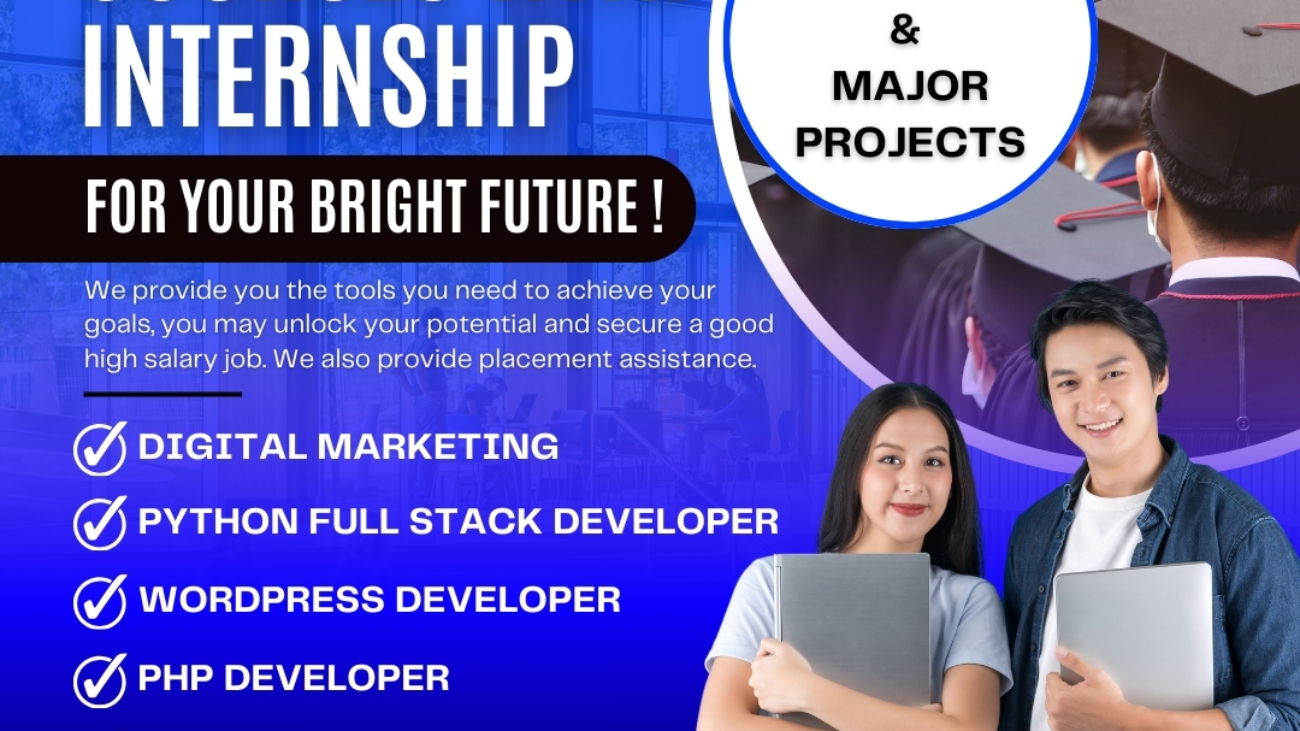
    • Digital Marketing: 6 months(3 months class + 2 months free internship+ 1 month internship with stipend)

    • Python Full Stack Development: 6 months

    • Word press Development: 6 months

    • PHP Development: 6 months

    • Graphic Designing: 6 months